


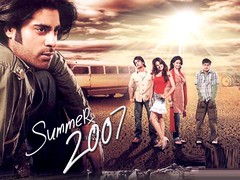
Summer 2007
wogma rating: Beg or borrow, but do watch (?) - At the very least watch it when it releases on DVD
Sure, we can choose to close our eyes once again to the farmer suicide issue because seems so distant. But, just like we read about it in the newspapers, write about it on our blogs, we should watch this movie because someone dared to make it.
Read more

Summer 2007 - Preview
NOT A REVIEW - Just looking at what we have next...
Of course my interest in this movie is more than average because I interviewed Gul Panag, one of the lead characters.
A quick glance through the official site tells you that Summer 2007 is about 5 young doctors from the city who go to the village to do their rural training. It certainly sounds different.
According to the director,
It is a tale of these five self-centered, fun-loving and ignorant youth who go through their metamorphosis.
Hmmmm..."metamorphosis"....I find transformation in characters very interesting. Is it one incident, is it a series of smaller ones. How much is just told, how much is shown using dialogue, situations, acting?
And then, he adds,
The protagonists never lose their humor and exuberance throughout the struggle and keep the momentum upbeat.
And the producer says,
Cinema to me is either about provoking a serious thought or to mindlessly entertain. With Summer 2007, I could probably be held guilty of entertaining and provoking a thought at the same time.
Oh nice! The last time this happened was in Lage Raho Munnabhai. If Summer 2007 turns out to be anything like that, what awesome entertainment that would be!
Another interesting aspect is that almost all the cast and crew are debutants or relatively new. The producer says,
One is extremely fortunate to be entering in to the film making business at a time when the cinema is changing and one wishes to carry the trend forward and also contribute to make it irreversible....It is changing because more and more people from the film industry as well as the audience are willing to experiment with unconventional stories, actors, technicians, soundtrack, etc... ...I compliment myself to be choosing to work with extremely talented and competitive new actors and technicians.......actually the list goes on and on.
Here's looking forward to something fresh this Friday...
- meeta, a part of the audience
The movie opens with a man standing in the middle of a lush green farm. And when you realize he is going to commit suicide, the contrast between the rich field and the poor man hits you like a bolt. No people, this is not a spoiler, it's a true life story. It's the story of over 150000 farmers who've killed themselves. We've already read about it in the newspapers. But now that we have a visual it will stay with us for a while.
Another contrast strikes when this scene cuts to three men behaving like boys. Arrogant and "kewl", Carefree and irresponsible, wannabe and dependent (Sikandar, Arjan Bajwa, and Alekh Sangal). Yes, the characters of the three friends are defined in these 5 minutes. Similarly, the two lead women, one an epitome of all things motherly, the other almost the exact opposite are etched out for us in the next 10 minutes (Gul Panag and Uvika Choudhary). Later, when we are introduced to the village doctor (Ashutosh Rana) too, we can sense how despite his helplessness, he's trying to help in the best possible manner.
Most of the credit for these clear definitions goes to the writing. The casual and aptly light lines in the beginning are of course done justice to by their delivery. But, somehow, there is a heavy tinge of artificiality in the performances except for those by Gul and Ashutosh. Gul is the cute momly figure we love to annoy and has a breathtakingly well-performed scene in the last half hour. Ashutosh Rana's performance shows a new facet of his talent. It is refreshing to see him in a non-villainous, soft role. Again kudos to some well-written scenes.
The transformation of these city based, hip, largely insensitive youngsters into working towards to a cause happens gradually and not ungrudgingly. However, all's not well as far as writing is concerned too. Uvika's and Alekh's roles are underwritten and lack depth after the initial exposition. Their motivations are not clear and because of that, I got the feel that maybe the movie could've done without them. Also the movie could have saved precious 20 odd minutes by keeping the absolutely dispensable songs out - both in terms of the music itself, and the way they are picturised.
I could also make observations about things like Sikandar's cringed nose and squinted eyes. But, I would then lose focus on what the movie is trying to aim at. One would be absolutely right to say that none of the departments of film-making seem to have been delved into 100% - be it writing, acting, or other technical aspects like camerawork or editing. But, full marks at attempting to describe the complex issues involved in the farmer suicides.
Yes, there are a whole load of sub-plots, but each one shows a different link in the chain of events that leads to the ultimate breakdown of the farmer who grows us our daily rice and dal (lentil curry). At many points in the movie, I was wondering why is this movie being targeted towards the multiplex audience when the issues they are trying to resolve are situated in a land far, far away. And that is THE point.
It is aimed towards me and you, browsing the net looking for reviews of the latest release. It is to sensitize us to what's happening out there or rather in there, in the interiors of the country. It doesn't offer any earth-shattering, practical solutions. In fact it alludes to the fact that we are intelligent people out here. Why don't we do something? What? How? When? That's for us to figure out. They have given us the why.
Maybe one of the solutions is to have us do rural training as a part of our education - why only medical students? Engineers, managers, accountants, artists can contribute too. Is it that farfetched? It's not that impossible to reach out to our sensitivity, is it? Of course, the going is hardly going to be easy. The most righteous of us will be wronged, but the most unsympathetic can also be made human.
I am thrilled. Thrilled that new things are being tried in Hindi cinema. Be it, the narrative style in Aamir or the most abstract use of metaphor in No Smoking or a theme that moviemakers wouldn't dare touch with a yardstick like in Summer 2007. All of them have commercial doom written all over them. And not just because of the way they are made, but I'm sure even on paper, the people involved knew very well that it's not going to make moolah. But, it is their urge to tell their story that brings these stories to us. Of course, I would be even more thrilled if Aamir and Summer 2007 did well at the box office. But I'm glad that the unlikelihood of financial success didn't keep the movies from being made. And at the very least Summer 2007 serves as documentation of how things were in India in the '00s and how we reacted to them.
- meeta, a part of the audience
Thumbs up, by Chuman Das, indiatimes : ...The director has convincingly worked on the transition of the protagonists from carefree collegians to concerned citizens... full review
Thumbs up, by Ashok Nayak, Now Running.com : ...There are quite a few flaws in the Summer 2007 script but the movie hits you hard... full review
So-So, by Fatema H Kagalwala, Business of Cinema : ...A more celebrated casting would have added value and credibility to the already uphill task of engaging uninterested consciences to a cause that is but a small news item in the daily papers.... full review
So-So, by Khalid Mohamed, Hindustan Times : ...only if Tatari could have curbed his zeal to say too much, all in one go... full review
So-So, Movie Talkies : ...Gul was slightly disappointing simply because she didn't really have much to do and hence couldn't add much to the characters... full review
So-So, by Nithya Ramani, Rediff : ...Sikandar's acting is amateurish... full review
So-So, Upper Stall : ...In it’s scope, it is far more expansive than Rang De Basanti in the issue it tackles: farmer suicides in Vidharba.... full review
Thumbs down, by Aparajita Ghosh, Apun Ka Choice : ...But the biggest flaw in the movie is that it doesn’t follow a single course.... full review
Thumbs down, by Daliya Daspurkayastha, Bollywood Mantra : ...The film has been directed nowhere and the message that it tried to convey was very confusing and went above the head of the audience.... full review
Thumbs down, by Martin D'Souza, Glamsham.com : ...The intention is good but the execution is juvenile.... full review
Thumbs down, by Rajeev Masand, IBN Live : ...may have had an interesting germ of an idea, but it's so loosely written and so poorly directed that in the end it just reminds you of what detention felt like in school.... full review
Thumbs down, by Taran Adarsh, IndiaFM : ...should've focused on the core issue and in turn, controlled the running time to approx. 2 hours... full review
Thumbs down, by Hanumant Bhansali, Radio Sargam : ...http://www.radiosargam.com/films/archives/12972/movie-review-summer-2007-2008.html... full review
Twitter reviews for this movie are not available.
This page has additional observations, other than the ones noted in the main review.
Plot Summary
Five final year medical students end up in the innermost parts India as a part of their rural training. What they see there in the Summer of 2007 and how they react is what we watch in this almost 2.5+ hours movie.
What Worked
Coming soon
What did not
Coming soon
Nitty-Gritty
Coming soon
Parental Guidance:
Mild spoilers in this section
- Violence: A fair measure of violence. One hospital scene where the glimpses of the surgery are shown.
- Sexual content: A couple of strong rape scenes. While there is no crass sexual innuendo, the canteen conversation is between boys who have little respect for anything, let alone women.
- Concept: The concept of farmer suicides is way beyond the understanding of a 10-12 year old. While I understand that we would like our older children to be aware of social issues, I think they would need to be prep'ed against the shock that the visuals might bring.
- General Look and Feel: While there are light moments through most of the film, the jokes borderline adult jokes. Also the ultimate feel of the film is very serious.
![[Facebook page of Summer 2007]](/static/images/icons/facebook_small.png)
![[Wikipedia page of Summer 2007]](/static/images/icons/wiki_small.png)
![[IMDB Page of Summer 2007]](/static/images/icons/imdb_small.png)
![[Gul Panag twitter account]](/static/images/icons/twitter_small.png)
Comments (14)
[...] Meetu strongly recommends Summer 2007. Sure, we can choose to close our eyes once again to the farmer suicide issue because seems so distant. But, just like we read about it in the newspapers, write about it on our blogs, we should watch this movie because someone dared to make it. Linked by BA. Join Blogbharti facebook group. [...]
[...] is very impressed by Summer 2007 and its focus on the farmer suicide issue. It is aimed towards me and you, browsing the net looking [...]
Interesting issue touched by the film makers there for sure...Thanks for the lovely review! I'll catch this flick for sure!
Thanks harry. Do let me know how you like it.
Hello all,
As you see in "Articles linking here", Ash of DesiPundit has been kind enough to link to this post.
Atul Pandey, the producer of the movie happened to read the post there and left a comment. We have been interacting on the comment space there. I have copy-pasted the exchange here, in case you are interested.
!!! spoiler warning !!!
* * *
Hi, this is atul - i produced this film. i did so as i was mad to make a film and it could not have been frivilous. I am not too sure if the film would be ringing bells at the box office-though i would love to get my money back to make more such film, but it is an honest effort. Most of us involved in producing this film are better human beings compared to what we were when we started studying the content of/for the film. I really appreciate and am truly overwhelmed when people laud our effort - irrespective of the success of the film. I may not entirely agree when ASH says that the film does not offer any solution to the rural poverty, agrarian crisis, lop sided development issue but i salute her for mentioning that we have to prick our minds to search for solutions. We have not told a very complicated story - its just a real/realistic story. If you wish to know what solution i have for all this mess, well, for starters lets look beyond our AC car windows, realise there is a problem and probably develop compassion for our co-humans in India and elsewhere. Once we do that, i am sure newer ideas would make way to help the childrens of lesser gods. D’caprio said a wonderful line in Blood Diamond, “i think gods left this place long time back’. Lets put an effort to get the gods back to the homes of those who need it more than us.
* * *
My reply -
!!! spoilers in this comment !!!
Hey Atul, thanks for putting your heart and money in bring this issue to us.
I was actually referring to Shankya’s dialogue in which he alluded to the fact that the micro credit system is an idea conceived by a common criminal like him. But, educated people could have better ideas if they set their mind to it.
And I was sharing the same sentiment with the readers that we should think of solutions instead of expecting the movie to come up with a 100% practical solution.
Thanks, once again!
* * *
Atul's reply -
Hi meetu, Please dont thank me. I am actually touched by your support to the cause of (if i may say) poor of the world. I absolutely agree with you when you say “we are intelligent people out here. Why don’t we do something?”. We have been majorly affected by Bhagat Singh and we have very subtly tried to adopt it in the last scene. Rahul had an option of not surrendering to the cops and remain free once he was out of the village (he was an escapist, he did it to sudents who were going to vote for him at college) but he decides to get arrested, put his point of view in the court and use his fathers influence to get the media to report the issue. He knows that when a big guy goes to jail everyone wants to know the reason. The solution will start from a point when we as a nation and a generation would acknowledge that there is a problem which needs to be addressed.
* * *
My reply -
!!! Spoilers in this comment !!!
Yeah Atul, I liked what Rahul did in the end. In the strangest way, it was sad and yet, inspirational.
Also, from the writing part of view it was nice because the transformation was to the other extreme of what his character was, but, it didn’t look unbelievable. The events that happened in between made him change gradually.
No social reform can happen overnight, so yes a baby step is to realize that there is a problem. And it need not be only in this particular area, right? So much around us needs to change. It will be great to try and make whatever little change in whatever way we can.
Do let me know if you get a chance to read the whole article.
Thanks!
Will keep you guys posted if there is any more interaction.
Thanks for stopping by and keep coming!
Hey Ridhima, uhh...it was named Summer 2007 because the event took place in the Summer of 2007. In a way, i think it is to record what the state of the country, its youth, its politics was around this period.
---
Thanks a ton, Atul! Those words are truly encouraging. I was wondering how you'd react to things I didn't like in the movie.
About "Try and read your reviews before deciding on seeing movies." - Glad to be of help! Do let us know what you think.
Well Ridhima, I think it serves the purpose. But, like you, I'm always interested in the process of how they decide on a name. I think commercial attractiveness is also a requirement. Anyway, what's in a name, right? :)
Great - I agree to all the good that has been said about the movie here.
Really appreciate the effort made by Atul Pandey and Suhail Tatari.
I had been reading about the farmer suicide issue in the newspapers and watching it on news channels, but after watching the movie i realise that the print and electronic media were never ever close to it.Though it dosent affect our daily life, its really important for people like us to know and understand such issues.
Completely agree with you, Udit and Harshad
Hi Guys
been a while i visited here. its exciting you people are still talking about S7. Recently, about 500 farmers saw the film in Allahabad, UP. Young and Old and some women as well. An organisation named SANCHETNA had organised the show for them. I could not have missed an opportunity to get the first hand view of how they would react to the film. I reached around interval. The theatre was probably showing one of its last films before making way for a plex. It was real bad condition - smell, rats, seats that threatened to sink. I am sure poor farmers were not thinking what i was about the state of the theatre. There was pin drop silence in the theatre-just some bit of excitement during the tamasha song. Women had tears during Shankya's speech, some older men too. when the show got over and the media converged onto these people, i could hear some rebellious comments like "hum soodkhor se mukti paana chahte hain" etc. 3-4 of them somehow realised that i dont look normal, they asked what had i got to do with the film. They hugged me hard and told me "bhaiya ye filam nahin hai .... aandolan hai".
Last few days have been extremely harsh on us, we have lost a lot of money on S7 but those words have travelled back with me and i have a glint of smile as i recall the incidence and write this mail.
My driver's words (who is from Samastipur, Bihar) echo "Sahab Bilkul aise hi hota hai". We told the story of someone in Vidarbha - it is true for every poor farmer everywhere in India.
Thanks for dropping by again, Atul! I'm pretty sure that's how it is everywhere in India.
A very good friend of mine has worked in the most interior parts of Maharasthra and was a part of the padyatra last year. He has seen things up close. I recommended this movie to him, more to see his reaction than anything else.
Unfortunately, right now he's in Afghanistan on an assignment and won't have access to Summer 2007 till his next trip to India. I was wondering if there is a CD, I could borrow from you and send it across to him.
I know commercial success would have been gratifying, but kind and heartfelt words from people whose lives the movie touches is irreplaceable.
hi Meetu
we have made it to the Indian Panorama. congratulate me soon. cheers...
Heartiest Congratulations!! Wish you all the success!!!
very good, it's very useful to me, thank you very much!
Leave a Comment