no gossip, no scandals.
movie reviews ... and more
wogma tip: ! ! NEW ! ! To place order for your FilmyTee, click here ! ! NEW ! !

Review - buddha mar gaya: Yuck!

buddha mar gaya

quick review: An easy winner for the most distasteful comedy ever!
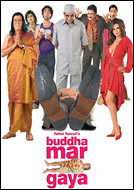
[Poster for buddha mar gaya]

95 minutes of runtime
= 30 minutes of direct crassness
+ 0 innuendos needed because of direct crassness
+ 35 minutes of disgusting dark humor that ultimately makes you sick in the stomach
+ 30 minutes of people shouting stuff that I had no inclination to understand

95 minutes of runtime
= 45 minutes of borrowed music
+ 45 minutes of the loudest background score
+ 5 minutes of one original(?) track

95 minutes of runtime
= 7 minutes of Rakhi Sawant's boob show (*whatever!*)
+ 3 minutes of Anupam Kher telling you that you will die laughing (*liar*)
+ 10 minutes of Ranvir Shorey's over-acting (*sob*)
+ 25 minutes of Om Puri, Anupam Kher, Prem Chopra, and Paresh Rawal having sex (*yuck!*)
+ 5 minutes of cat-fights (*hmph*)
+ 5 minutes of literal "aaaaaa" shouting (*headache*)
+ 40 minutes of other cast being generally deafening because that is the genre of the movie (*more headache*)

95 minutes of runtime
= 3 funerals
+ 1 Rakhi Sawant saying, "Sigmund Freud"
+ 7 (at the last count) soap opera-ish sleeping around
+ 3 distasteful gay jokes
+ 1 slap on womanhood every time a woman comes on screen
+ 1 reveiwer wanting to know who enjoys this kind of comedy

95 minutes of runtime
= 90 minutes of reviewer wanting to get out of the theater
+ 5 minutes of reviewer trying to hide her face while getting out of the theater
+ 32 number of minutes of reviewer hating her job for the first time ever

- meetu, a part of the audience

buddha mar gaya - Movie Details

buddha mar gaya - Trailer

buddha mar gaya - All reviews summary

External Reviews

11 reviewers have given buddha mar gaya an average rating of 0.5/5.0. 1 yays, 10 nays, 0 so-so. See all external reviews »

Readers' Ratings

3 readers have given buddha mar gaya an average rating of 3/5.0. 1 yays, 0 nays, 2 so-so. See all reader reviews »

Comments (8)

PutVote.com:

Review - Buddha Mar Gaya...

An easy winner for the most distasteful comedy ever! ...

Seema Randive:

I loved the way you wrote the review... wonderfully written

epifinibox:

@tsk_tsk:

1) Your statements are contradictory. On one hand, you say Hollywood lacks originality ‘coz it’s movies are ‘copies of books’ and on the other you condone Indian plagiarism since it adds to the ‘beauty of the originals’ which, according to you, are highly unoriginal in the first place since they are mere copies of ‘original’ books. Therefore, do you mean to say ‘copy of a copy’ is better than ‘just a copy’??

2) My dear, a film that is based on a book is called an 'adaptation' for christ's sakes, not a 'copy'( if you do not know what is an adaptation and the kinds of adaptations, read en.wikipedia.org/wiki/Film_adaptation. You will get an idea.). An adaptation is an age-old tradition of art of movie-making as it helps a film-maker to explore the facets of life that otherwise lie outside his experiential jurisdiction hence inaccessible. Adaptation is a technique that enables the filmmaker to draw from the collective perspicacity of the authors whose works he can now convert into screenplays. Because, from a deepest creative viewpoint, making movies is an impossibly unsustainable task i.e. one cannot keep on making great movies drawing from one’s own experiential pool alone however abundantly imaginative one's mind is. Literature, therefore, frees the mind of a film-maker from the experiential restrictions the life imposes on every human by default by offering him a clear vision of nuts-and-bolts of infinite variants of a singular life force culled from the innumerable experiences/inventiveness of the innumerable authors. Vast literature, both in terms of quantity and quality is only the means by which we can unfurl the Life on the silver screen in it's myriads. What’s the point?? The point is, the tradition of writing adapted screenplays to make powerful movies is not a luxury but a sheer necessity born out of the need to free the art of film-making from the shackles of experiential restrictions the Life essentially imposes on the filmmaker(on any human being for that matter) . Hence, I should say, only a wide-eyed greenhorn moviegoer with an half-baked know-how of art of film-making would dare claim full-fledged legal adaptations to be 'just copies'. Forgive me for my harsh observations, but I cannot help it as your comments can potentially mislead someone who is very eager to believe that the 'scam'(scum) called 'Indian cinema' is actually on par with Hollywood.(I think you are that same hardportugese guy who responded to my comments on Gamyam).

3) Apart from the above, the plagiarist never acknowledges the original; he neither pays for the original source he copies nor he acknowledges in public that he copied or inspired by a particular work. He boldly or tacitly claims the work as his own. That's unethical besides being illegal. Did you see Ajay Devgan or Radha Krishna of Gamyam mention 'The Notebook' or 'Motorcycle Diaries' in their public Q&As; or pre-release/post-release promos let alone the credits?? No, they wouldn't. Never. Doing such a thing is actually against the ‘conscience’ and ‘spirit’ of a plagiarist. However, if you please read the reviews of the film The Notebook or watch its credits, you will notice that they clearly mention it as the adaptation of the Nicholas Spark's novel with the same name (in fact, Nicholas Spark is famous for writing many musty romantic tales some of which were made into movies. Remember ‘A Walk to Remember’ or ‘Message in a bottle’ which was actually lifted by that idiot Puri Jagannath to make a trash called ‘Sivamani’?). Same thing goes for ‘The Motorcycle Diaries’. The screenplay and the film clearly mentions that it is based on Ernesto Guevara's travelogue ‘The Motorcycle Diaries’. They actually say that it’s based on so-and-so novel by so-and-so author. Why?? Have they gone out of their minds??. They do so because they pay for it. They pay a million bucks to the original author as a token of acknowledgement of his work. Hence, before being anything else the plagiaristic movie-making is, first and the foremost, in a strict legal sense, an illegal copy of the original by committing which you a) trespass the rights of the original novelist to earn the royalty for his original work b) trespass the commercial privileges of the original film-maker who actually earned the rights for adapting the novel by paying a fat sum to the original author c) deprive original author/original filmmaker of his artistic license to celebrate the applause of the audience, which they are ethically entitled to. If anything creative, be it scientific or artistic, can be copied just like that on a mealy-mouthed plea that ‘duplication’ is necessary to reach a wider audience/beneficiaries, we may as well remove the words ‘patent’ and the ‘copyright’ from our legal dictionaries. If you are right, we can invent a vaccine for AIDS without ever being grateful to Louis Pasteur or make a Satellite phone without ever acknowledging the work of Graham Bell (in fact, we, the Indians, wouldn’t even make a satellite phone. We would make something that looks like a telephone without a diaphragm or a transmitter and claims it to be a superior variation of the original telephone. We say, of course, who is Graham Bell, anyway.). You said all plagiarism is not evil. But the very word plagiarism denotes an ‘evil copy’. Therefore, first, please learn the difference between the words ‘Adaptation’ and a ‘Copy’, ‘Remake’ and ‘Plagiarism’. In a very simplistic licit terms, the former are legal and the latter are illegal(In a creative sense, the latter are very often vastly inferior to the original. At least Indian versions). Why can’t Radha Krishna say in public that his movie is inspired by ‘Motorcycle Diaries’, why can’t Devgan say his idea for UMH germinated from ‘The Note Book’. Why don’t they at least acknowledge the works of Ernesto Guevara or Nicholas Sparks ( Do you think the thieves actually knew the movies they stole are adaptations?? Do you mean to say they actually read the original source??). If these guys are really brimming with passion for cinema, why couldn’t they grab these books in the first place before Hollywood did it and make the movies out of them themselves?? If you are really straight and honest, why do you have to wait for someone from Hollywood to pay millions for the novelists and work their asses off to write an adapted screenplay so that you can lift the concept straight from it? Why don’t you dig up the literature yourself, pay for it and make a movie out of it? Even if your insincere plagiaristic work is forgiven, what’s stopping you from publicly applauding the work of the original author at least for giving you that killer idea that earned you millions??? (Most of the original Hollywood/chinese/Korean works, the lazy indian film-makers steal, are inferior products themselves). Apart from all this, do you mean to say Indian film-makers exclusively plagiarize only those Hollywood movies which are based on books and do not actually copy any 'original screenplays'?('Changing Lanes' into 'Taxi 9211' and 'Collateral' into 'The Killer' etc., etc.,. This list goes on endlessly. I believe Mumbai is probably the piracy capital of the world). The Chinese, Korean film-makers do not adapt novels as frequently as Hollywood does as they shoot C-grade action flicks most of the time. Then why do we steal these movies as regularly as we steal Hollywood, though the source of these movies is not often a book??

4) You said a copy occasionally adds to the beauty of the original. Firstly, in the context of quality of Indian movies, please replace the word 'occasionally' with ‘rarely’ or 'never' as most of the Indian plagiaristic works wrench the theme of the original out of its natural narrative and distort it in the name of nativity(Refer to my comments on Gamyam). However, at the end, most of these ‘free remakes’ actually either draw their situations or dilemmas of its characters out of elements of American culture or varnish the hyper-cliched Indian narrative with the stolen theme. In case of the former, the quality of the copy is naturally becomes inferior to that of the original, whose basic theme much more readily blends into its plot since they were both derived from the same cultural resource. In case of the latter, however, the stink of the underlying stereotypical narrative and characters usually overwhelms the deodorizing scent of the ‘stolen theme’, unless, of course, you are suffering from acute artistic anosmia (the inability to smell), like it happened in Gamyam.

Secondly, just tell me who is going to talk about the ‘original’ let alone it’s ‘beauty’. If you are actually conceding that the source of a copy is a ‘beautiful original’, shouldn't it's existence be acknowledged first before making a copy?? Shouldn’t the ‘cool guys’,who enjoyed the ‘cool movie’ UMH, have to applaud the original ‘cool’ movie ‘The Note Book’ that made the secondary ‘cool’ movie UMH possible or remember Nicholas Sparks who wrote such a ‘cool’ novel which is actually the source of both the ‘cool’ movies??(Even the fad of using the word 'cool' often is aping an Yankee ex-pression).

5) As for your having a laugh about my remarks about victimization of Hollywood etc., I would say everything you said minus your misplaced sarcasm holds true. Yes. They pay a fat purse to get the copyrights and they do toil hard to write an ‘adapted screenplay’ and we copy their ‘original adaptation’. Of course, it’s criminal. Since, it takes considerable visual imagination and story-telling talent to condense a 600 page novel to a crisp 120 page adapted screenplay or to expand a simple single-line description of a scenario or a character of a paperback into a long set of detailed meaningful visuals, The Academy of Motion Picture Arts and Sciences actually presents an Oscar for the 'Best Adapted Screenplay' apart from awarding the 'Best Original Screenplay'. In fact, the films that win Best Picture Oscars are often made of the adapted screenplays. Last year's Best Picture 'The Departed' and this year's 'No Country for oldmen' have won an Oscar for Best Adapted Screenplay as well. Scorcese's Oscar-winning remake 'The Departed' boldly declares it's screenplay is based on that of 'Infernal Affairs'(The 'Pather Panchali' of the great Satyajit Ray is actually an adaptation of Bibhutibhushan Bandopadhyay's novel of the same name). Like-wise, innumerable Hollywood flicks over the decades have been adaptations of novels, real-life stories, comic books or short stories. Adapting literature isn't any warped new phenomenon that gives you a pointer to 'lack of originality' in Hollywood as you amateurishly claim. In fact, it is one of the primary reasons why Hollywood could be able to come up with such a vast number of 'original' story lines which are generously copied and deformed by the freebooters called Indian filmmakers and why Hollywood is such a Juggernaut in the realm of motion pictures.

6) You spoke of Hollywood producers to be millionaire bastards. If someone who pays millions for something he takes is a bastard, then what should we call someone who makes millions out of something he stole and produce such perfectly bastardized movies?? Mean-SOBs, pimps??. Your tirade against Hollywood producers there seems to be a case of a typical jingoist vehemence, born of an acute sense of inferiority, of a dabbler who has an inkling that the kind of cinema he gets a kick out of is indeed a shallow ill-gotten lovey-dovey fare.

7) Is the Indian cinema in the pink of its health or it is betraying an ugly yellow of a deeper cultural malady? The problem with the Indian Cinema is more about the kind of films it makes than the kind of movies it cannot make. It is more about the alarming depths the sensitivity of it's audience has fallen off the minimum acceptable perceptual threshold of a cross-section of generic movie-buffs of any other culture. If Om Shathi Om is an rigorously recycled decoction of super-absurdity that defies the universal notions of ‘entertainment and art’, which only Indians can find 'entertaining' and are capable of making, ‘Bheja Fry’ is an insipid cinematized stage-play that can only look good in contrast with an atrocity called OSO and hardly the basis on which you can claim parity with Hollywood, which not just refined but actually invented new genres of filmmaking. OSO - Bheja Fry wouldn't denote the range of versatility or two ‘divergent forms of ingenuity’ of Indian Cinema as you tacitly imply, rather they only represent a 'chronic disease' and it's 'inevitable side-effect' respectively. There is a thick line between 'originality' and 'quackery', 'inventiveness' and 'contrivance', ‘discrepancy’ and ‘diversity’. The fact that Bheja Fry is not based on a book wouldn't make it great, on the contrary, lack of ample quality contemporary literature is a major reason why Indian Cinema still resorts to either recycling ‘conventional junk’ like OSO or outright stealing from foreign cinema in order to cash in on the new generation of ‘half-exposed/unexposed’ moviegoers who demand ‘new thrills’. Hence, the metamorphosis of Indian cinema, which seems to be ‘pink of its health’, is more on the lines of ‘commercial invention’ than ‘creative evolution’. Artistic caliber is not only measured in terms of the heights it can achieve but also in terms of the lows it cannot succumb to. From that perspective, the ‘highs’ and ‘lows’ of American Cinema(or any other foreign cinema) simply operate at a higher level than the ‘highs’ and ‘lows’ of its Indian counterpart as it is intrinsically immune to the anomalies, which you mistake to be novelties, that plague Indian Cinema. (Why the hell OSO, which ought not have been made in the first place, should do as well as it ought to have?? Skewed, isn’t it?? Only a psychopath would make a movie like OSO for American audience or even ‘Bheja Fry’ for that matter).

8) The films you mentioned, Pirates of the Caribbean, Lord of the Rings (visually, probably the best trilogy in the entire film history of the world) etc.,etc., are comic book adaptations, a form of adaptation the Hollywood has virtual monopoly over. Though India doesn’t have a comic book culture, the comic book adaptations of Hollywood have actually resulted in their dowdy Indian versions of superheroes like Mukesh Khanna’s Shaktiman, whose premise is generously and unabashedly copied from that of American Superman and that superman+batman+spiderman hodgepodge of Krrish. Shaktiman was a hugely popular television series and I don’t remember Khanna ever acknowledging publicly about where exactly he got his idea of Shaktiman from. India do not/cannot produce comic book adaptations not because it has the will to produce only magnum opus of other genres but because the comic book films require huge budgets, great visual imagination and very healthy screenwriting traditions none of which Indian filmmakers have besides the total absence of quality comic book literature. Nevertheless, I reiterate that India doesn’t have substantial contemporary literature to have a tradition of adapted screenplays and what it produces mostly is crude rehashes of back-dated/brand-new foreign cinema and it’s weird to hail it as ‘original’ than the very industry whose ‘narrative structures’ and ‘movies’ it unflinchingly steals from as a means of its survival. (I cannot imagine what would have been your reaction had Mumbai produced Lord of the Rings and Spielberg made an American version of the crappy DDLJ). Though the Hollywood is rife, of late, with comic book adaptations, especially after the runaway success of Lord of the rings, I don’t understand, why should it necessarily mean Hollywood lacks originality when its production of films in other genres easily outnumber, both quantity-wise and quality-wise, the production of films of similar genres of Indian movie industry, most of which are, in reality, 'very remakes' of American films?? Moreover, of the million movies the Hollywood makes every year only a fraction comprising of big-budget action adventures, sci-fi/comic book adaptations or films of branded directors arrive in India to tap the potential commercial market of that common universal movie ‘mob’, which barely reflect the vibrancy of real Hollywood.

9) Did it actually hit the wall?? Does American cinema suffers from dearth of originality?? Yes. It does. But it's at another level. There used to be a tennis great called Ivan Lendl, who could never be able to win even a single Wimbledon final. Though Ivan Lendl is considered to be one of the greatest of tennis players ever born, somehow, the grass courts of Wimbledon seemed to expose a 'weakness' in his technique. Then should we say Ivan Lendl is as good or bad as someone like Ramesh Krishnan just because Krishnan played some of his greatest tennis only on grass courts?? No, we don't say that, do we?? Lendl's game on grass courts is predictable and unidimensional only in comparison with other 'equally-talented' top players with who he had to compete with at Wimbledon and we say he is a 'failure at Wimbledon' only with reference to the 'level of success' he had had on other types of courts at other times against other great players at the ‘level he competes at’. Simply speaking, Lendl is only considered 'incomplete' because his 'success' at Wimbledon is disproportionate to the general level of finesse he could be able to achieve in the game of Tennis itself(Lendl reached Wimbledon finals twice. Had Ramesh Krishnan done that it would have been hailed as one of the greatest Indian sporting achievements ever). Likewise, Hollywood can only be called 'stereotypical', 'unoriginal' and 'lagging-behind' only with reference to the degree of refinement a film industry with such an illustrious past and pedigree ought to achieve in the art of filmmaking but not in comparison with an industry whose very substratum for its 'new-age cinema' is Hollywood's very own(and mostly obsolete) 'narrative structures' and 'leitmotiv'. Hence, India's so called 'in-vogue' cinema is hardly an equivalent parallel cinematic alternative to Hollywood as most hypocritical Indian movie fans would like to believe, rather it is only an inferior subsystem of its 'American parent' whose movies and literature are profusely used as its aesthetic fuel for sustenance (why? even the word 'Bollywood' is a variation of Hollywood. Do the French call their movie-industry 'Pariswood'??). Don't you think the lead poster of convergent line of slick, muscle-bound leather-jacketed hunks and cleavage-flaunting halter-topped ladies dangling LMGs of a typical Bollywood action flick reeks of its third-grade out-of-date Hollywood counterpart??

10. You say Originality is rare...India or not etc.,. Yes, it is. But the infrequency of that 'rarity' in India is so greater/wider/bigger/larger/deeper/higher than any other movie industry that it makes you wonder originality actually exists/can exist here.

meetu:

epifinibox, i've no clue where this came from...but...ok...

epifinibox:

I am sorry meetu. Actually, my previous post was supposed to be my reply to tsk_tsk's comments on my comments I'd posted at some other movie website's review on Devgan's 'U Me Aur Hum'. I'd opened your website and theirs simultaneously and mistakenly pasted my reply to tsk_tsk on the other site into the comments box of your site, when I was reading your Buddha Mar Gaya review. However, since you are not going to remove my misplaced comment above, I furnish the communication between me and tsk_tsk on the other site hereunder so as to avoid confusion.

tsk_tsk wrote on 15th Apr, 2008, 5:37pm:

"@epifinibox: The Notebook itself is a copy - of the book. Like Motorcycle Diaries was - of the book (referring to your comments on Gamyam). The point being - all "plagiarism" is not evil. It occasionally adds to extend the beauty of the original to a wider audience.

As an aside, your comments about Hollywood filmmakers being “victims” really cracked me up - I needed a laugh like that - thanks! Poor millionaire bastards - they toil blood, sweat and tears to grab hold of a book and make it into an “original” movie, and some guy copies their “original” script – criminal!

Though I cannot comment in as fancy a language, I must say that Indian Cinema is in the pink of its health. Indian Cinema has never been better or bigger – for every Om Shanti Om we’ve had a Bheja Fry – both doing as well as they ought to have.

If at all, its Hollywood that’s lacking “originality” – Pirates, Lords, Narnias, Spidermans, Iron Mans, Stephen Kings – do you have anything that’s not a book? Yes sir we do – Die Hard 4, Re-Rambo, Re-Rocky, Re-Indiana Jones, Re…

Originality is rare – everywhere –India or not...."

epifinibox wrote on 13th Apr, 2008, 11:54pm:

"Buddy, it's a crude lift of Nick Cassevetes's The Notebook. Read it's review at reelviews.net/movies/n/notebook.html. Another shameful and impudent robbery by Bollywood. The humongous plagiarism taking place in Bollywood at present assumed a very severely contagious form of the most unscrupulous and unchecked art piracy and I feel it is high time the French/Korean/Chinese/Hollywood writer/director/producer victims are notified of the millions that are being milked out of the ‘free remakes’ of their originals at a ‘certain part of the world’ behind their backs. A special international court at UN to prosecute these thankless art burglars wouldn’t be out of place. I fail to understand for the life of me, whether this type of rampant forgery is just a preliminary part of a bigger artistic evolution taking place in Indian movie industry or a hideous mutant natural sequence of movie-making that has stubbornly entrenched itself in odious cultural hypocrisy, unrepentant indulgence in repulsive lyricism and blatant intellectual inertia for time immemorial. If we ever can see the light at the end of this long dark rancid tunnel called ‘Indian Cinema’, I certainly consider it a miracle....."

Hence, my post on your site is a sequel to the above two comments. Sorry for the mispasting.

regards

epifinibox

Tamillyrics.co.in:

For all Tamil Songs Lyrics
Visit: http://www.tamillyrics.co.in

Hindilyrics4u.co.in:

For all Hindi Songs Lyrics
Visit: http://www.hindilyrics4u.co.in

Telugulyrics.co.in:

For all Telugu Songs Lyrics
Visit: http://www.telugulyrics.co.in

Leave a new comment